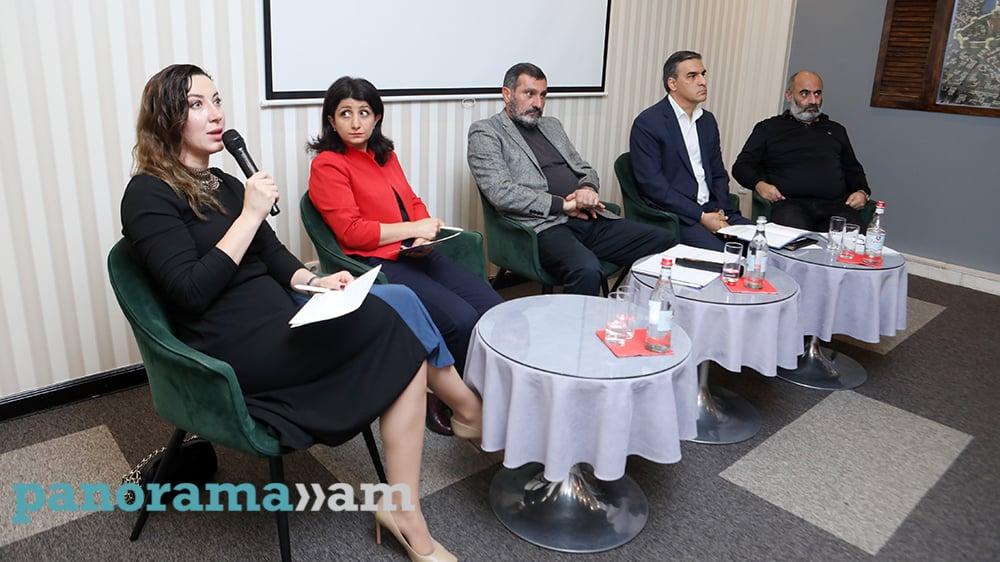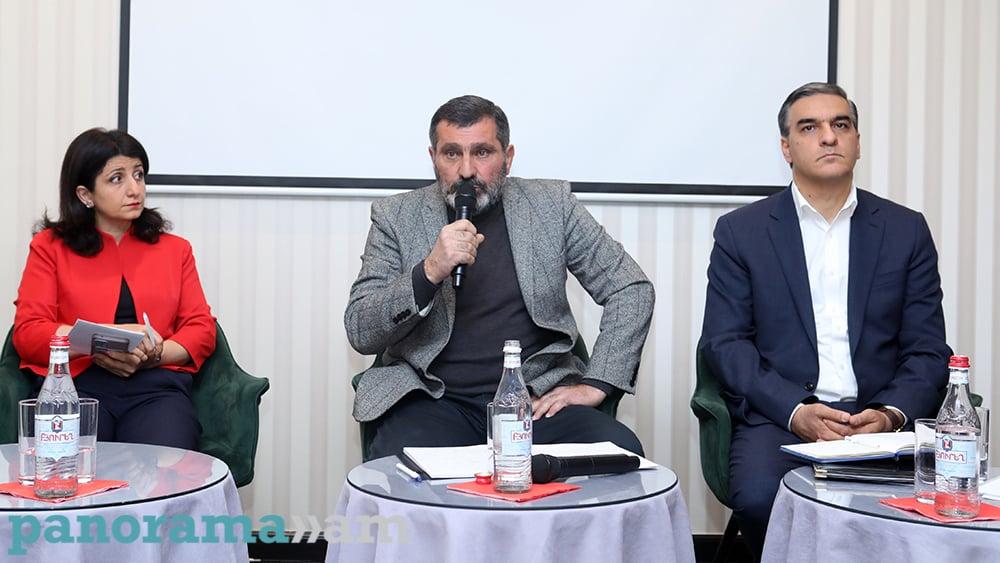
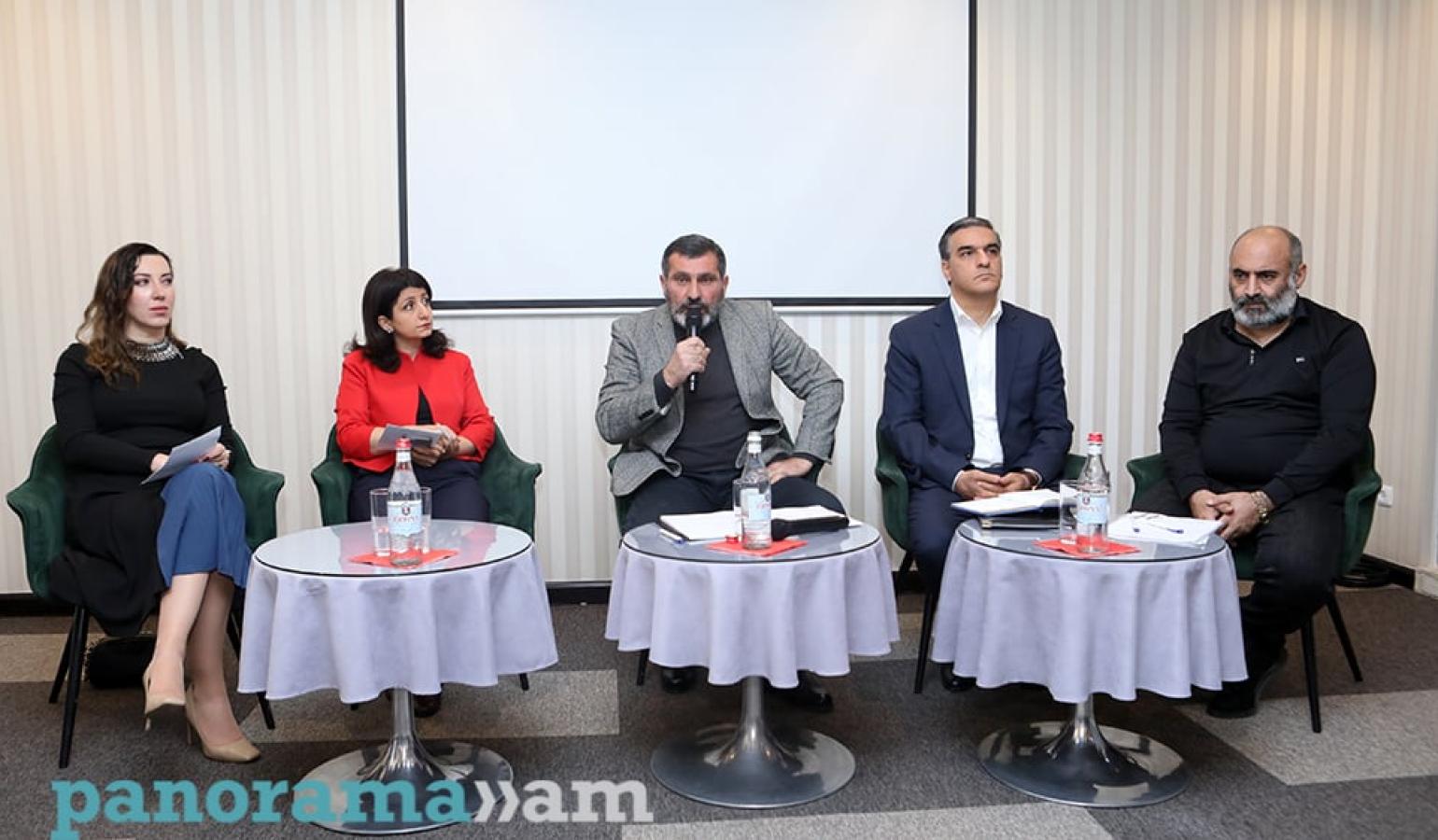
On December 10, International Human Rights Day, a press conference was held at the initiative of a group of parents of missing persons on the topic “The issue of missing persons as an unresolved urgent human rights problem.” The press conference was attended by relatives of missing servicemen, the director of the “Center for International and Comparative Law,” Siranush Sahakyan, the director of the “Tatoyan” Center for Law and Justice Foundation and former Human Rights Defender of the Republic of Armenia, Arman Tatoyan, and the director of the NGO “Protection of Rights Without Borders,” Anna Melikyan.
Siranush Sahakyan considered it important to speak specifically about the problems of missing persons on Human Rights Day, as the issue is multi-layered. There is, of course, also the unresolved issue of prisoners of war, but according to Sahakyan, if we compare the two, in the case of prisoners we at least know their whereabouts, there is certain work that can be carried out which may lead to the release of that group, whereas in the case of missing persons we cannot bring them back until we determine their whereabouts.
According to Sahakyan, the issue of missing persons requires an international response. Remaining in a state of prolonged uncertainty, when the actions of the state do not lead to positive developments, the families of missing persons continuously endure suffering that can even be qualified as psychological torture. “We are dealing with a group that becomes a victim of prolonged torture, whereas torture is absolutely prohibited. Moreover, we mostly talk about the need to combat physical torture, but seem to ignore the issue of psychological torture. And under these conditions of uncertainty, families are unable to exercise a number of interconnected rights; for example, human dignity is violated, family and private life are in many cases simply excluded, and the exercise of many other rights becomes impossible. In particular, issues such as funerals, the inability to bury the remains of the deceased in accordance with religious beliefs, cause ongoing pain and suffering,” says the human rights defender.
Siranush Sahakyan discusses the raised issue on two levels: interstate and domestic. The interstate issue mainly concerns Azerbaijan. “Unfortunately, the last known locations of the missing persons are currently under Azerbaijani control, and the ability of the investigative or other bodies of the Republic of Armenia to independently carry out investigative actions is significantly limited,” says the human rights defender.
Sahakyan also points to domestic issues, emphasizing the clarification of the legal status of missing persons. “It is noteworthy that despite the fact that our state has for a long time been in frozen or active phases of conflict, Armenia lacks a law establishing the legal status of missing persons. Attempts were made back in the 2000s. In particular, in 2007 there was such an initiative, which unfortunately did not yield results. After the 44-day war, discussions intensified, a draft circulated, but even five years later we still do not have a draft that would acquire the force of law and clarify the status of these persons,” the human rights defender records.
Without clarification of status, the state’s policy regarding the social component of the issue is also not systematized, nor are psychological support and, why not, the investigation of cases. There are many norms scattered across different laws and branches of law, there are many responsible actors, but no single central body has been formed under whose responsibility and coordination all issues would be resolved. “In our assessment, it is imperative that the law establishing the legal status of missing persons enter into force as soon as possible, which should be followed by a unified and clearly defined state policy on providing them with psychological, social, and legal support,” says Sahakyan.
Anna Melikyan spoke about 1,300 missing persons recorded from the early 1990s up to and including September 2023. According to the human rights defender, their fates have not been clarified, there have been limitations on search operations by Azerbaijan, and for that reason many questions still require clarification. “Objective concerns have been voiced that in those territories, in Nagorno-Karabakh and surrounding areas, Azerbaijan is carrying out large-scale activities, in particular construction work and exhumations, which are completely uncontrolled. We have concerns that even if remains are found that should undergo proper DNA examination to determine to whom they belong, we will continuously hear Azerbaijani state propaganda claiming that ‘the remains of this many people have been found, which are certainly victims of Khojaly.’ But under no circumstances can we be certain whose remains they actually are. Especially regarding cases from the 1990s, there is a great deal of information indicating that there are burial sites where the bodies of deceased Armenians rest. From this perspective, conducting an effective investigation is important,” says Melikyan.