
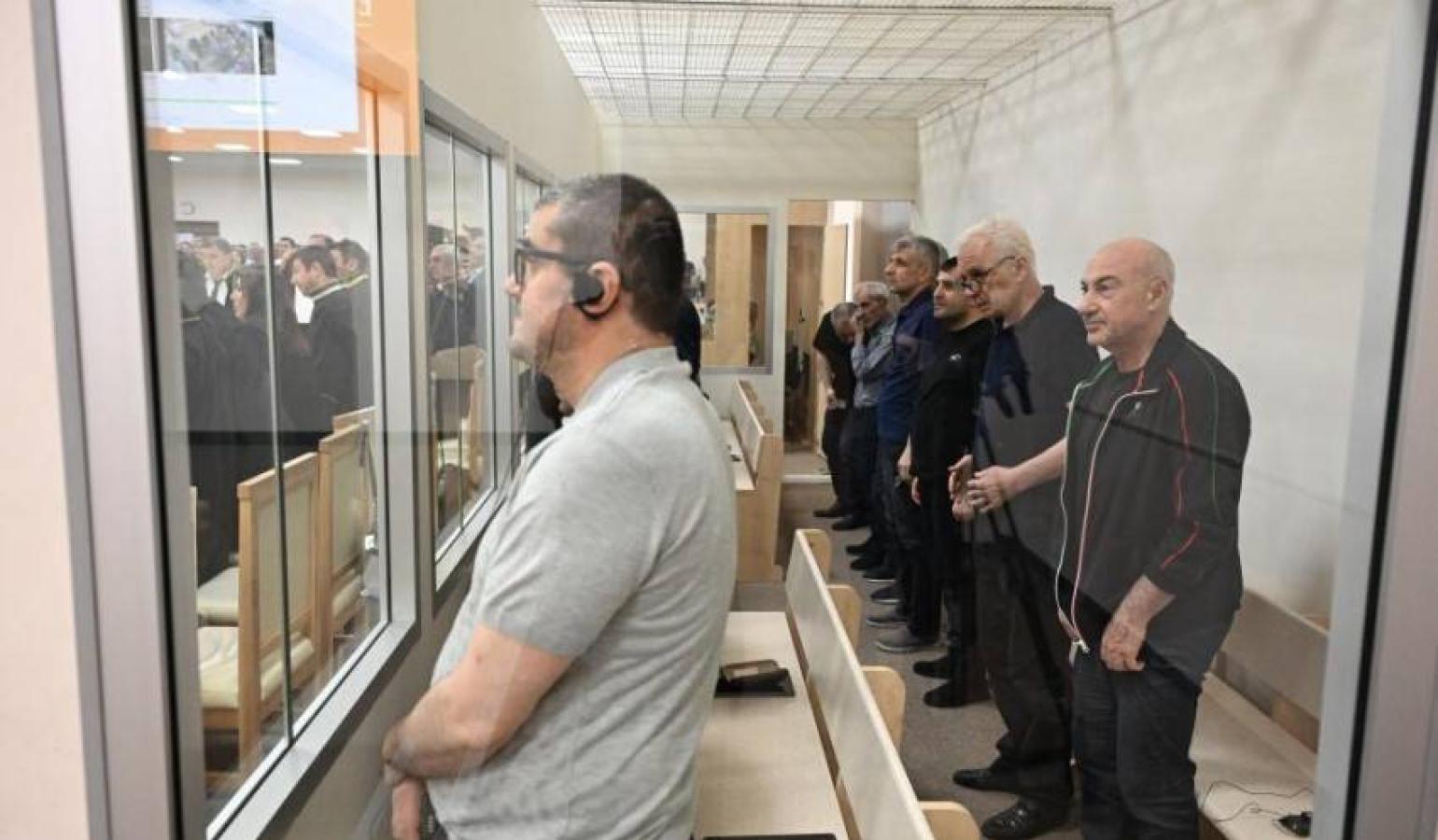
Siranush Sahakyan, Director of the Armenian office of the International and Comparative Law Center and the Armenian Legal Center for Justice and Human Rights, addressed the ongoing developments related to the protection of the rights of Armenian prisoners and hostages held in Azerbaijan during a discussion held at the presentation of Karen Bekaryan’s book “International Matrix,” presenting the existing legal proceedings, international responses, and key challenges. Referring to the return of Armenian prisoners held in Baku, Sahakyan emphasized that when speaking about the return of 19 Armenian prisoners, Karen Avanesyan should also be included. Although his captivity occurred under different circumstances, he is an ethnic Armenian, and his conviction is substantially connected to the Nagorno-Karabakh conflict; therefore, the issue should be viewed from the perspective of the complete repatriation of at least 20 Armenians. Moreover, according to Sahakyan, the issue is not limited solely to repatriation and also includes clarifying the fate of forcibly disappeared persons, which continues to remain an unresolved humanitarian issue. In the cases of both the prisoners and the forcibly disappeared persons, uncertainty persists. “In one case, the uncertainty is conditioned by the absence of a settlement, where the issue appears to be left exclusively to the discretion of the Azerbaijani authorities, which is also evident in their rhetoric. For example, in response to the European Parliament resolution emphasizing the political call for the unconditional release of the prisoners, Azerbaijan reacted by accusing it of interfering in the country’s internal affairs, saying, ‘What business do you have with “their prisoners”?’ In the case of the missing persons, the uncertainty stems from the fact that it is unclear what mechanisms or negotiations exist, prior to the document entering into legal force, that could urgently resolve the issue,” said Sahakyan.
The human rights defender noted that very serious doubts continue to persist regarding the legality of the “trials” carried out by Azerbaijan. According to Sahakyan, although formal appeals have been submitted to Azerbaijan’s higher judicial instances, there is an interesting nuance here: the defendants and their Azerbaijani lawyers still do not have access to the verdicts and have not seen the full texts, because the state does not provide them, mainly limiting itself to excerpts, which are, of course, absolutely non-informative. “But on the other hand, we do have appeals filed by Azerbaijani lawyers themselves. In this case, it is unclear how, without access to the judicial acts, they have been able to effectively appeal and, presumably, defend the rights of the Armenians,” said the human rights defender. She also considered it important to remind that the European Court of Human Rights has obliged the Azerbaijani side to provide the judicial acts or their reasoning, which is of significant importance for subsequent international legal protection. Sahakyan informed that additional international legal proceedings have already been initiated in a number of cases, including submissions made to the relevant mechanisms of the United Nations. At the same time, the submission of several cases to the European Court of Human Rights is also being discussed.
According to Siranush Sahakyan’s assessment, one of the main obstacles to resolving the issue related to the repatriation of Armenian prisoners is its extreme politicization. According to her, detained individuals are often used as instruments of political influence, as a result of which the issue loses its exclusively humanitarian nature and becomes part of political arrangements.
Referring to the recently active discussions concerning possible consular or institutional visits, Sahakyan noted that such initiatives should be evaluated not only from a humanitarian perspective but also from the standpoint of legal guarantees. In her opinion, the involvement of the European Committee for the Prevention of Torture could become a more effective and reliable mechanism, as it possesses the relevant mandate, procedural guarantees, and international authority. “In 2025, this same committee visited Azerbaijan. I should note that it visited all the closed institutions where Armenian prisoners are being held and met with them. The report was provided to the Azerbaijani authorities in 2026, however, to this day Azerbaijan has not given its consent for its publication. Therefore, we may assume what kind of picture regarding torture is described in that report, if the state is avoiding its publication at all costs,” said the human rights defender. Sahakyan also emphasized that more active and consistent involvement by the Armenian state authorities is necessary in ensuring family visits, communication, and the exercise of other fundamental rights of Armenian prisoners. According to her, without coordinated state and international efforts, families are practically deprived of the opportunity to fully exercise their rights.
In conclusion, Siranush Sahakyan emphasized that the issue of protecting the rights of Armenians held in Baku requires simultaneous legal, diplomatic, and international institutional efforts until the restoration of their rights and their safe repatriation.