
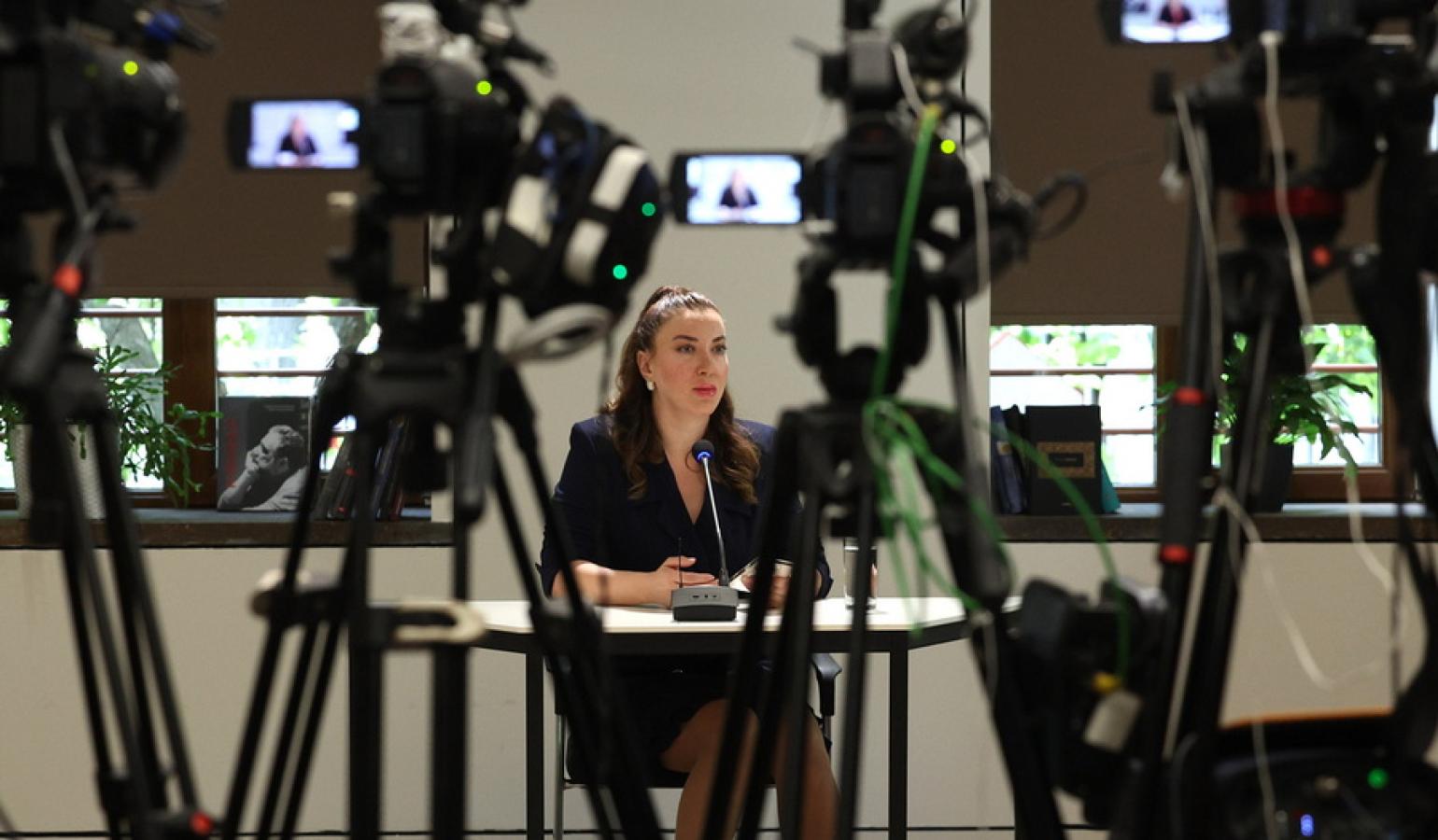
Siranush Sahakyan, Director of the International and Comparative Law Center and representative of Armenian prisoners of war at the ECHR, held a press conference on September 4. During the briefing, she presented the results of an examination of the Baku court's verdict regarding Ruben Vardanyan, highlighting the legal issues and human rights violations documented during the judicial proceedings. Ruben Vardanyan was sentenced to 20 years in prison by the Baku court, and on July 19, an application was submitted to the European Court of Human Rights in his case.
According to Siranush Sahakyan, a detailed review of the verdict reveals no direct testimony regarding specific criminal acts committed by Ruben Vardanyan. In particular, in various episodes of the verdict, witnesses described various incidents but did not testify that Vardanyan personally participated in them, issued relevant instructions, or made decisions.
"What is absurd is that, yes, there are witnesses who testified that, for example, they transported journalists to Karvachar, during which a mine exploded and injuries were sustained. Curiously, these witnesses begged and implored the court to apply the harshest punishment specifically to Ruben Vardanyan. However, there is no testimony that the witness saw Ruben Vardanyan mining Karvachar or issuing relevant instructions," said Sahakyan.
According to the human rights defender, a similar pattern exists in other episodes. Specifically, during his career, Ruben Vardanyan implemented various charitable programs, including the construction and renovation of schools and kindergartens. In another instance, Vardanyan funded a large wedding in Artsakh, and his role as a godfather at that wedding was characterized by the prosecution as criminal activity.
"Neither in international law nor even in Azerbaijan's new domestic legislation is there any norm that could turn being a wedding godfather and providing financial assistance to newly formed families into a criminal act—even if those families lived in a territory whose government declared independence but lacks international recognition," said Siranush Sahakyan.
The human rights defender also addressed the fact that several actions attributed to Vardanyan pertain to a period before he assumed the office of State Minister of Artsakh. Sahakyan assessed that the criminalization of Artsakh's state structures and Vardanyan's charitable activities - including those linked to the Aurora Humanitarian Initiative - raises serious questions regarding individual criminal responsibility and legal certainty.
"If the court bases a person's liability not on a specific act individually committed by them, but on their connection to a structure or political process, a fundamental issue of individual criminal responsibility arises," emphasized Siranush Sahakyan, noting that these issues have also been presented to the ECHR. According to her, the European Court must also evaluate the extent to which the acts attributed to Vardanyan comply with the requirements of legality and legal predictability under Article 7 of the Convention.
The press conference also addressed the detention conditions of Armenians held in Azerbaijan, their health status, and restrictions on contact with the outside world. Sahakyan stated that the detainees lack access to independent doctors, Red Cross representatives, and fully independent legal counsel, making the information received from families regarding health issues all the more concerning.
Furthermore, Sahakyan presented a humanitarian visit initiative for the Armenians held in Azerbaijan. Specifically, Ruben Vardanyan's wife, Veronika Zonabend, proposed visiting the Armenian detainees alongside a group of female human rights advocates to deliver personal items, photographs, and letters. However, executing this initiative requires both the consent of the Azerbaijani side and coordinated efforts among relevant state and diplomatic channels in Armenia.
Sahakyan also mentioned a strong desire to publish the verdict in the case of the 15 Armenian POWs, though they are currently unable to do so. "The issue is that the document accessible to us regarding the case of the 15 is not the full text. “At this moment, I, as their lawyer and legal representative before the European Court, am deprived of the opportunity to access that judicial act and examine the grounds thereof. The family members are in a similar situation and, indeed, so are the public defenders in Azerbaijan,” the human rights defender explained.